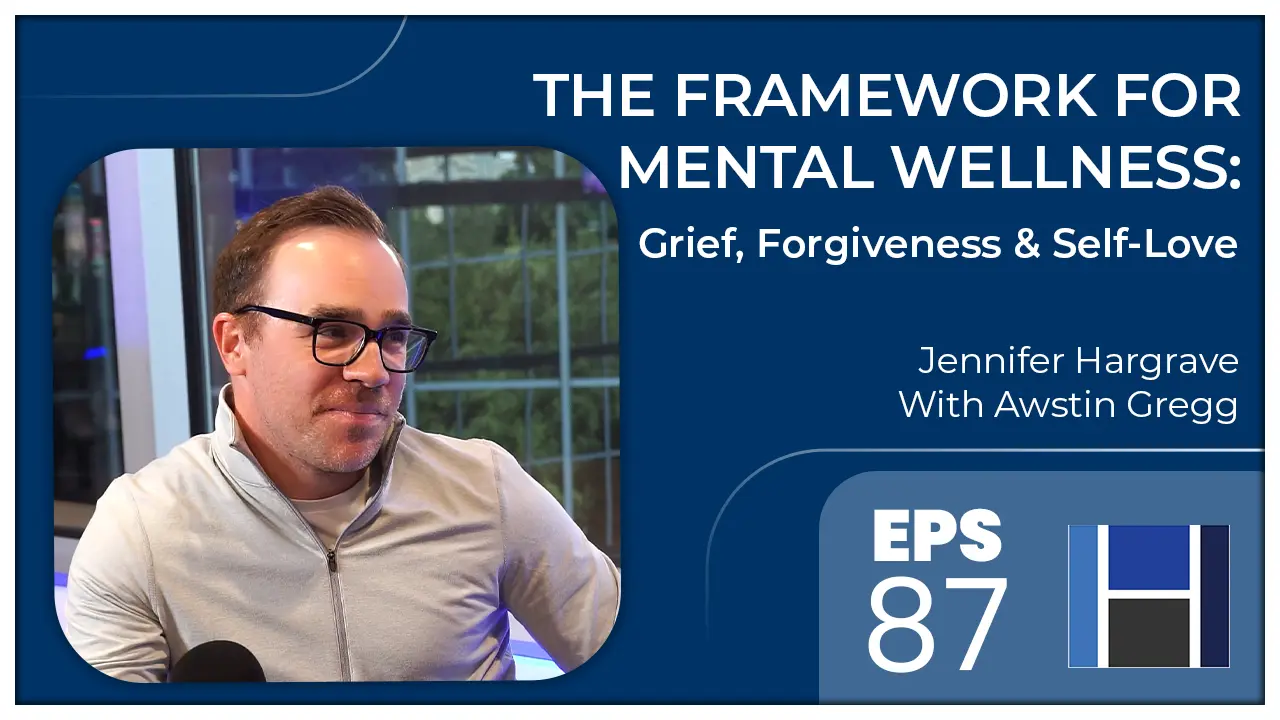
Episode Summary:
In this profoundly moving and insightful episode about coping with divorce, Jennifer Hargrave sits down with Awstin Gregg — a healthcare entrepreneur, clinician, and global mental health speaker — to explore the foundational frameworks for emotional wellness. According to Austin, 99% of mental health issues can be improved with the right belief-based framework. Together, they unpack three essential pillars: forgiveness, grief, and self-love.
Divorce is a whole-person challenge, and coping with divorce improves when you follow a clear framework for mental wellness during divorce. We discuss practical ways to process grief after divorce, practice forgiveness after divorce, and rebuild self-love after divorce, while strengthening co-parenting communication. With steady habits and support, healing after divorce becomes a sustainable path—not a sprint.
Gregg shares how deeply ingrained beliefs shape our behaviors and emotions—often without us realizing it. He walks through how unprocessed grief, unpracticed forgiveness, and performance-based self-worth can hold us back from living a vibrant life. He also emphasizes that emotions like sadness or grief are not problems to be fixed, but essential human experiences that need to be honored.
Listeners will gain practical insights on:
- Why grief often stems from unmet expectations and doesn’t need to be “solved”
- How forgiveness, especially self-forgiveness, is more about reclaiming your story than letting someone off the hook
- Ways to rebuild trust with yourself and shift internal dialogue from critical to compassionate
- The importance of asking life-shaping questions like “Who am I?” and “What do I want?”
This episode is a must-listen for anyone feeling stuck, emotionally numb, or navigating a major life transition. Whether you’re grieving a loss, healing from betrayal, or simply seeking a more meaningful inner life, Awstin Gregg’s wisdom offers a grounded path toward emotional freedom and transformation.

Full Transcript:
Jennifer Hargrave:
99% of mental health issues can be resolved with the right framework, according to my guest today, Awstin. Awstin Gregg is a healthcare entrepreneur, a professor, and a clinician. He’s asked to speak around the world and is known globally for his powerful talks. It is such a privilege to have him here with us today. Awstin, thank you so much for taking the time to talk with us about mental health.
Awstin Gregg:
Of course, Jennifer. Thanks for having me.
Jennifer Hargrave:
We met at a conference and started chatting. Our conversation took a turn into this fascinating topic, and you really captured my attention. Let’s talk about what you mean when you say 99% of mental health issues can be resolved with the right framework. What are the necessary elements for mental health?
Awstin Gregg:
So much of what we do in life is driven by our beliefs—those deeply rooted ideas that form the foundation of who we are. But often, people don’t really know what their core beliefs are. When we do become aware of them, we may realize that some are irrational or unhealthy and are creating habits that lead to unwanted consequences.
In my clinical work, I’ve found that many behaviors, whether they’re tied to grief, anxiety, or simply a lack of vibrancy, often come back to three core beliefs. If we focus on these three areas—regardless of whether someone has a formal diagnosis or just wants to live more fully—they can be transformative.
Jennifer Hargrave:
That’s so exciting. I know the feeling of being stuck, and I work with people who feel stuck all the time. So what are these three beliefs we need to pay attention to?
Awstin Gregg:
They are: forgiveness, the ability to appropriately cope with grief and loss, and self-love. These may sound simple on the surface, but in practice, they’re deeply complex. I’ll often ask clients, “Pretend I’ve never experienced grief—can you teach me how to do it?” That question often brings silence—not because it’s hard to explain, but because many people realize they don’t actually know how to grieve.
The same goes for forgiveness. People hear that it’s for us, not the other person—but they still don’t know how to do it. And with self-love, when I ask people when they felt most loved growing up, they often answer, “When I won the game,” or “When I got straight A’s.” That teaches them they’re only lovable when they perform. As adults, if we don’t meet those performance markers, we begin to question if we deserve love—even our own.
Jennifer Hargrave:
Yes! So many of us were raised in environments where emotions were pushed aside. I grew up in a faith tradition with lots of language around forgiveness, grief, and love—but not the mechanics of how to actually experience them.
Awstin Gregg:
Exactly. The culture often teaches us to “tough it out” and keep moving. Grit is valuable, but the unintended consequence is that people were never taught how to feel and process these emotions. We teach kids how to tie their shoes or change a tire—but not how to grieve, how to forgive, or how to love themselves.
Jennifer Hargrave:
Yes! And instead of feeling, we try to medicate. I remember a mom once asking me for a referral because her child was grieving, and she wanted a doctor who would prescribe a pill. That speaks to how deeply we try to avoid discomfort.
Awstin Gregg:
Right. That reinforces the idea that the only acceptable emotion is happiness, and everything else must be eliminated. But without contrast, we lose the vibrancy of life. Feeling bad teaches us what good feels like. Accomplishment is meaningful because we know failure.
When we label certain emotions as “bad” or “undesirable,” we try to avoid them. That avoidance can lead to anxiety, numbness, burnout—and a life that feels like it’s stuck in neutral.
Jennifer Hargrave:
Yes, yes. So let’s start with grief. What’s the right framework for processing it?
Awstin Gregg:
First, grief is universal. Everyone experiences it. I define grief as arising from any unmet expectation—not just loss of a loved one. It can be the loss of a job, a role, even an identity. Sometimes it’s something you didn’t even like but still grieve.
The key is to stop trying to solve grief. Just experience it. Grief is patient. If you don’t deal with it, it will wait for you—and show up in other ways: anxiety, irritability, burnout.
Jennifer Hargrave:
I lost my mom four years ago. We had four months between diagnosis and her passing. At first, I didn’t want to feel the grief. But when it came, I found that leaning into it—allowing the messy tears, the pain—was actually beautiful. It didn’t last forever, but it taught me something sacred.
Awstin Gregg:
Exactly. Grief shows us what mattered. It tells a story of love and vulnerability. It’s messy—sometimes expressed through tears, sometimes music, sometimes movement—but if we avoid it, it calcifies.
And support is key. Grief can feel isolating not because we’re physically alone, but because it’s hard to articulate. A supportive community helps tremendously.
Jennifer Hargrave:
So powerful. I’ve come to see grief not as something to “get through,” but as a companion in life—something that shows up in different ways.
Awstin Gregg:
Yes, grief asks us not to move on, but to move forward with it as part of our story. It’s in those uncomfortable, sacred moments that life becomes more meaningful.
Jennifer Hargrave:
Let’s talk about forgiveness. That’s another really difficult area—especially when people have been deeply hurt.
Awstin Gregg:
Absolutely. Forgiveness is hard. Not only is it difficult emotionally, but many people simply haven’t been taught how to do it. The first thing to understand is that forgiveness is for us. It’s not about saying what someone did is okay. It’s about making peace with who we are in the aftermath of pain—and letting it become part of our story.
One of my favorite questions to ask is, “Who are you?” It’s a question most people haven’t answered in a long time, if ever. We’re made up of our experiences—both the joyful and the painful. Forgiveness plays a role in that self-definition.
Jennifer Hargrave:
That makes me think of how often we struggle to forgive ourselves. That’s often even harder than forgiving others.
Awstin Gregg:
Very true. Think about how often we break promises to ourselves—skipping the gym, not following through on goals. Over time, we lose trust in ourselves. And if we spoke to others the way we sometimes talk to ourselves, we’d probably cut them out of our lives.
Rebuilding trust with yourself starts with small, consistent acts. Don’t make promises when you’re happy, and don’t send texts when you’re angry—that’s a good starting rule. But more than that, it’s about changing your internal narrative.
Jennifer Hargrave:
Yes. And I think a lot of people have no frame of reference for what self-love even looks like. They’ve never seen it modeled.
Awstin Gregg:
Exactly. Many people have never been asked, “When do you deserve your own love?” If love was only given when they achieved something as a child, they’ve learned to tie their worth to performance. There’s nothing wrong with achievement—but if we believe we must earn love, we create a painful separation from it.
Jennifer Hargrave:
Wow. So insightful. What would be the next step for someone who wants to start changing those beliefs? Where can they begin?
Awstin Gregg:
Sometimes, we need a coach or therapist to help us see our blind spots. But the work often starts with asking the right questions: Who are you? What do you want? Who are you becoming? Are you aligned with the person you want to be?
The best answers in life often come not from knowing, but from asking. And if each day you go to bed knowing you took a small step toward becoming who you want to be, that’s where meaning and healing live.
Jennifer Hargrave:
For so many of my clients, who are going through life transitions, this conversation offers so much hope. These painful moments can become powerful turning points.
Awstin Gregg:
Agreed. When we allow grief to teach us, when we forgive, and when we love ourselves without condition, we unlock the next chapter of life. Grief and struggle are signs that we’ve allowed something to matter. That’s the heart of truly living.
Jennifer Hargrave:
Awstin, thank you so much. This was such a powerful conversation. Where can people find you if they want to connect or learn more?
Awstin Gregg:
The best place to connect with me is on LinkedIn. It’s Awstin—spelled A-W-S-T-I-N Gregg. I look forward to connecting there.
Jennifer Hargrave:
Wonderful. We’ll include that link. Thank you again for your time, Awstin. And to our listeners—thank you for joining us. We hope this conversation resonates and helps you in your journey. See you next time.
We’re more than just your attorneys
Ideally, child support is supposed to create a balanced arrangement that helps your child grow and thrive. Child-related expenses, like food, activities, doctor’s appointments, and education fluctuate depending on the age of the child. With the proper agreement, these needs and their possible fluctuations will not compromise the child’s well-being.