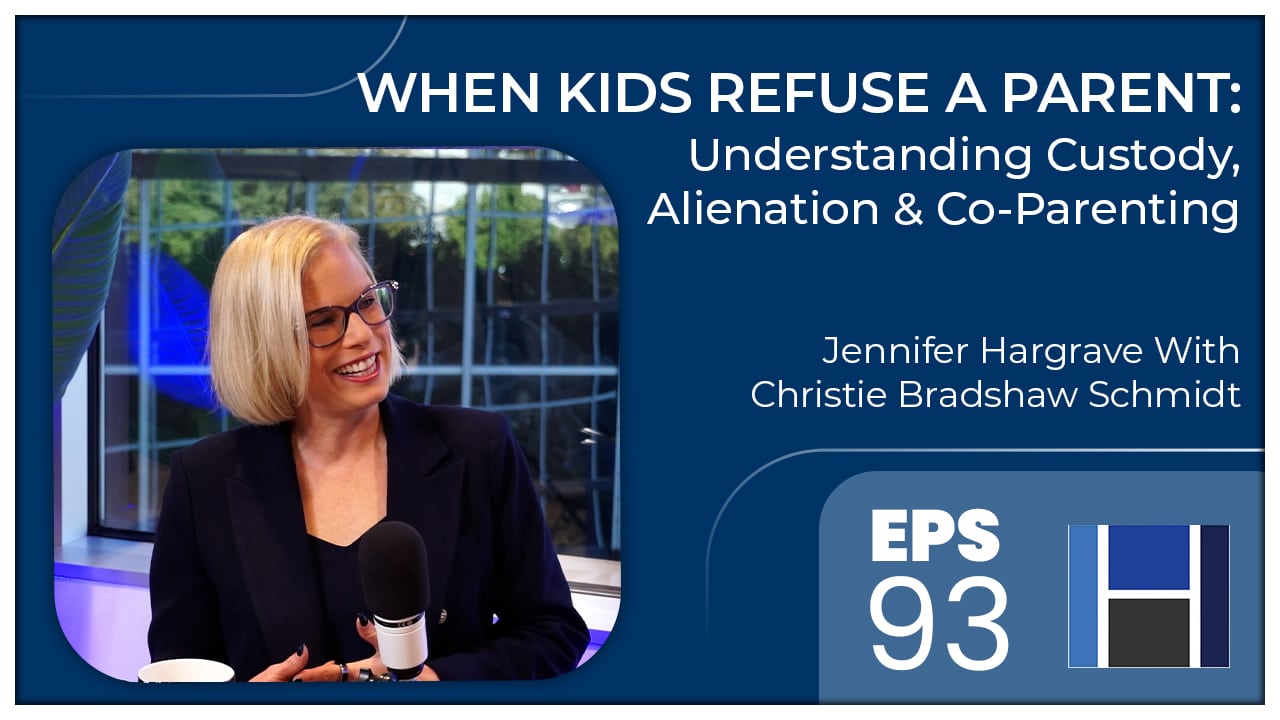
When Kids Resist a Parent: Dallas Divorce Attorney Talks Custody, Alienation & Co-Parenting Solutions
When a child starts resisting or refusing time with a parent after divorce, it can be heartbreaking and terrifying. In this episode of The Jennifer Hargrave Show, Dallas divorce attorney Jennifer Hargrave sits down with custody expert Christy Bradshaw Schmidt to unpack what’s really going on when kids say, “I don’t want to go to Mom’s” or “I don’t want to see Dad.”
Together, they explore the difference between healthy alignment, estrangement, and true parental alienation, and why most families are actually living in a complicated “hybrid” of several issues at once. Christy explains why a child’s resistance is not always the other parent’s fault, how high-conflict co-parenting fuels the problem, and why subtle behaviors—eye rolls, tone of voice, side conversations—can quietly undermine a child’s relationship with the other parent.
Jennifer and Christy also discuss practical steps rejected parents can take to protect and repair their relationship with their children, including therapy, family counseling, and strategic co-parenting with court orders in mind. They highlight how a strong co-parenting relationship supports healthier custody outcomes and how working with a Dallas divorce lawyer experienced in complex custody and collaborative divorce can help families avoid long-term cutoffs and estrangement. If you’re in North Texas navigating divorce, child custody, or alienation concerns, this conversation offers validation, concrete tools, and a powerful message of hope: don’t give up, and always keep the door open.
Refined Transcript
JENNIFER HARGRAVE:
At what age does your child get to decide how much time he or she is going to be spending with a parent?
This is a common question that a lot of family law attorneys get asked by clients who are in the divorce process or in a custody dispute. It’s also usually a sign that a child is resisting spending time with a parent for some reason.
My guest here today is an expert in this realm. Her name is Christy Bradshaw Schmidt, and I’m so excited to sit down with her and have a conversation about the dynamics where children are resisting a parent.
So thank you so much, Christy, for being here.
CHRISTY BRADSHAW SCHMIDT:
Thank you for having me. I’m thrilled to be here.
JENNIFER:
The first thing I want to do is start from a very high level. What are some of the reasons why children resist spending time with a parent?
CHRISTY:
What we know now from the literature is that there are lots of reasons.
There’s enmeshment, which is where a child feels bad for a parent. They feel that a parent may have been wronged in the divorce, and they feel that parent is not okay if they’re not with them. So they kind of take on that parent’s emotions and feelings in a very protective role, almost a parentified role.
There’s estrangement, where kids actually resist or refuse contact for justifiable reasons. Maybe you have a parent with an untreated mental health issue or a substance abuse issue. Maybe you have a parent who’s been uninvolved, or who just lacks some really good coping skills as a parent.
We have the big buzzword, alienating behavior, which is where kids are resisting or refusing contact for unjustified reasons—where it’s been influenced by a parent or a family member or sibling or someone else.
And then there’s alignment. They may just…you know, if a child found out their parent had an affair, they may see one parent as the “wronged” parent in that situation and want to align with them. Some kids just have an affinity for one parent.
JENNIFER:
Yeah. And that happens in intact families too, right?
That can be totally natural. So it’s not always an indication that there’s some kind of underlying pathology or that something is “wrong,” but it is something to pay attention to, right?
CHRISTY:
Absolutely.
JENNIFER:
What should a parent do if they’re feeling like they’re the rejected parent, and their child suddenly isn’t wanting to spend time with them? What do they do next? What do you usually suggest?
CHRISTY:
That’s such a great question. That’s the hardest place to be in, in these cases, because you are fiercely protective of wanting to maintain your relationship with your child.
It’s horribly painful when your child resists contact with you, especially for unjustified reasons. It can also be hard even when it is justified, because that requires some ownership.
It’s really easy for parents in that position to get reactionary—to get angry and upset. And rightfully so. Those feelings are absolutely valid.
But we have to pull back. We have to think long term. We have to think strategically and try to figure out:
- How do I keep my side of the street clean and work on the things I need to work on?
- How do I try to co-parent with my co-parent to see if we can fix this?
- Do we need some therapy to start having conversations and to help all of us build coping skills to repair that relationship and move forward?
JENNIFER:
One of the things I know that’s really a hot topic these days is what you alluded to—alienation. There’s so much information out there on parental alienation, and I think for a lot of parents who are feeling rejected, reading about parental alienation can feel vindicating in some ways.
What are the dangers? Let’s talk about parental alienation.
CHRISTY:
Like I said, alienation is when a child is resisting or refusing contact for unjustified reasons.
In probably most of the cases you and I see on a regular basis, there’s some form of alienating behavior. It’s hard as parents going through divorce not to accidentally slip up and say something negative about the other parent—or even just roll your eyes at the mention of them.
JENNIFER:
Right.
CHRISTY:
Nonverbals are just as powerful.
But it’s also really easy to jump to the conclusion that alienation is the explanation. Those behaviors often exist, and there are absolutely cases where that’s 100% what’s occurring.
In my experience, though, a lot of them we call hybrid cases. There’s a lot going on that’s contributing. There may be some alienating behavior. There may be some poor parenting that needs to get fixed. There may be conflict that needs to be managed.
So usually it’s not just this one big word. We certainly want to watch for those behaviors and work to minimize them. But often, in the families I see, there’s more than one thing going on that needs to be addressed.
JENNIFER:
Yes, for sure. And when I think about the pattern of where we see alienating behaviors, usually there was at least a really good relationship—a good, strong parent-child relationship—and then events start to happen and, all of a sudden, the child isn’t wanting to spend time with a parent.
Can you talk about that a little bit? Why is it not always the other parent’s fault?
CHRISTY:
Exactly. It’s not always the other parent’s fault.
Sometimes it’s that Mom and Dad—or Mom and Mom, Dad and Dad—are in conflict. They have a high-conflict scenario that the kids have seen and been exposed to, and kids just want to pull back from that. They don’t want to be in the middle, so they’ll pick a parent to align with just so they can stay out of the conflict.
Sometimes it is alienating behavior that’s causing it—those outright direct or indirect, overt or covert, intentional or unintentional behaviors that paint the other parent in a negative light.
Or, like you said, it’s those nonverbals where the kids know the parents don’t get along. They know their parent doesn’t support their relationship with the other parent. It’s not okay to call the other parent to say, “I won an award at school today,” because they’re afraid it will make their favored parent angry. Kids know those things.
There can be overt and covert behaviors—even if it’s not classic alienation—that show a lack of support for the other parent. Kids pick that up. We want to watch for those things and figure out how to change them so that children can be taken out of the middle and allowed to have a healthy relationship with both parents and get back to that relationship they had before with the other parent.
JENNIFER:
Exactly.
Now, what happens if you’re the parent who is maybe the favored parent? The child wants to spend time with you, and they don’t want to go to the other parent’s house. What do I need to be concerned about on that end, and what steps should I be taking?
CHRISTY:
First of all, I never want to tell a parent, “Don’t believe your child.” But children don’t always tell the truth.
Anybody who’s had a two-year-old who says, “No, I didn’t take a cookie,” while having crumbs all over their mouth, knows that.
Kids also have a very limited worldview. They’re looking at the world through very limited life experience. So we want to listen and say, “Okay, what’s going on?” but we don’t want to immediately run to protective action based solely on that.
At the end of the day, if your child is struggling with going to the other parent’s home, a couple of things:
Number one, you’ve got to follow the rules—what your order says, what the judge has told you that you have to do, or what you’ve agreed to. You’ve got to follow the rules, and you want to teach your kids to follow the rules.
But if there’s anxiety or distress around going, then let’s go fix that.
If you had a child with school refusal, you might say, “Maybe we need to get some therapy to figure out what this anxiety is about, put some tools in their toolbox, and help them move forward.” You’d want to repair and fix things and get them on the right track.
Leaning in and saying, “You don’t have to go,” may not only land you in trouble, but it also makes things worse. It makes it much harder to repair that relationship.
JENNIFER:
One of the things I think parents don’t realize is that when they give in, they’re actually putting the child in control of the situation. In that moment it may feel like the right thing to do, but really kids don’t want to be in the middle. They don’t want to be making those decisions.
Am I right? Let’s talk a little bit about that from the child’s perspective.
CHRISTY:
It depends on the age.
You’ve got teenagers who will absolutely tell you they have a right to know what is going on. But we also know kids’ brains aren’t fully developed until their mid-20s. They have parents for a reason.
What they think they need to know or control is not necessarily what’s in their best interest.
Sometimes telling them “No,” and “I’m sorry,” and “I hear you and I understand and I can validate your feelings”—without giving them control—is the healthier choice.
Parents’ goal is to raise independent, self-sufficient adults, and to teach them how to deal with hard times and hard experiences. So if they’re having anxiety or stress, let’s learn how to deal with it, not just avoid it.
JENNIFER:
Now, obviously there are times where, if something serious is going on—like substance abuse, or the other parent is in an abusive relationship—and there are underlying safety concerns, then those are reasons to take legal steps to protect the child.
CHRISTY:
Absolutely. And you still want therapy, because that child needs coping skills to understand what’s happening, regardless of the schedule.
If they’ve got a parent with a substance abuse issue, they may need psychoeducation about what that means and what it looks like.
Preferably, we want to get that parent into therapy and have them do some work together to repair things and get back on track, if possible.
JENNIFER:
I always say, as a parent you have this very strong desire to protect your child from anything bad happening—and that’s a good desire, especially when they’re little and dependent on your protection.
But I also tell people that the more important role we have as parents is to prepare our children. That’s where therapy is such a powerful tool to help them differentiate and make sense of everything that’s going on.
CHRISTY:
Exactly. And I try to teach parents this: when they say, “But this is happening at the other parent’s house and I have to tell them how to deal with it,” I say, lean into life lessons.
If they come home upset about something that happened at the other parent’s home, take it out of the divorce context. Ask, “What would you do if that happened with a teacher? What would you do if that happened with a friend?”
You’re teaching them life skills and tools without tying it directly to their parent. That prevents you from speaking negatively about the other parent and keeps you from undermining that relationship, while still giving them what they need to grow into healthy adults.
JENNIFER:
Do you see parents who maybe have gone to court, don’t agree with the court order, and simply don’t follow it? How does that work out?
CHRISTY:
Usually not well, in my experience.
If those are my clients in a consulting role, I tell them: you have to follow the order. That is the rule—unless you all want to reach a new agreement and co-parent that issue differently.
We don’t get to ignore what we agreed to once the court signed off on it, or what the court has ordered. Those are the adult rules we have to follow.
JENNIFER:
So let’s talk a little bit about how you work with families. What is your role, and what options do parents have if they’re in one of these situations?
CHRISTY:
I do a lot of custody evaluations. That’s part of my job. It’s a court-ordered neutral role. I only do so many of those, but the goal is to help the court decide what’s really going on.
So if you have a case where a child is resisting or refusing contact, the only person who can say what’s happening and why, other than the judge, is a custody evaluator. You have to do a full evaluation of everyone in the family to really understand the reasons behind the resistance or refusal.
That’s one part of my work.
Another large part, besides providing expert testimony for families on this topic, is consulting with attorneys in a confidential role. That includes:
- Helping attorneys with strategic legal support related to the mental health issues in the case.
- Coaching parents through the process—talking about slowing down, breathing, not making reactionary decisions.
- Helping decide whether a parent needs their own therapy, whether we need to get the child into therapy, and how to do that.
Even if it feels like all of this is being done to you as the rejected parent, the reality is you actually have a lot more control and influence than you realize.
JENNIFER:
Absolutely. So what steps can that parent take to change the dynamic on their side of the street?
CHRISTY:
First, let’s focus on their side of the street.
Step one: get your own therapy.
Step two: reach out to the other parent to see if you can co-parent your way into family therapy.
If that’s not possible, that can be a good reason to use the court and say, “We need family therapy here before this gets any worse.”
If you’ve got resistance—but not yet outright refusal—time is your enemy. The sooner you get into therapy and get the family working, the more likely you can prevent a complete cutoff. That’s goal number one.
Your child’s own therapy is also important. Family therapy is important.
I recognize all of this costs money, so you have to weigh that, but your child having that support can be crucial.
And if you’re struggling personally in that role, trying to figure out how to keep your side of the street clean, remember: every parent has a part in this. Even if you are “technically innocent,” there’s always something you can do better as a parent.
Lean into that: What can I do differently? If my kid’s complaining about something that seems trivial, can I listen and make some small changes?
JENNIFER:
I think that’s so helpful for parents, because if you’re the one who’s been rejected, there are a lot of feelings—grief over the loss of the relationship, anger, hurt.
When you’re with your child, the child can trigger you and say things that are really painful and make you feel very defensive. There are a lot of ways that are completely natural for a parent to respond, but in that dynamic, those reactions can be really destructive.
CHRISTY:
Exactly. It’s emotionally charged and stressful.
Sometimes you just have to pause, take a breath, and be the parent—the adult—in that moment.
It’s okay to say, “I’m frustrated right now. I’m going to take a break. You hang out in here for a minute, and I’ll be back,” because if you react in the moment, it may not go well.
Give yourself permission—unless your child is in an unsafe situation—to take a timeout.
JENNIFER:
And in fact, you’re teaching your child a very important lesson in that moment.
CHRISTY:
Exactly. You’re modeling what you want them to do.
Remember, their brains aren’t fully developed. They’re still learning coping skills. They may be lashing out because it’s the only thing they know how to do, or because of anxiety or fear, real or imagined.
Teach them how to manage that.
JENNIFER:
Is it true that sometimes, when a child actually feels safe with a parent, that the parent may experience more of the emotional breakdown from that child?
CHRISTY:
Yes. Sometimes kids will react more strongly with the parent they feel safest with, because they know they will be heard and held. It becomes a sort of emotional release.
So just because your child is having a lot of negative emotions around you doesn’t necessarily mean it’s personal to you.
JENNIFER:
Right. Kids don’t really understand what’s going on in all of these dynamics. They know how it feels—lots of big feelings and big emotions that they may not have the tools to manage.
Don’t feed into that with them. Be the adult. Be the parent. Take the breaks you need. Use your own toolbox.
CHRISTY:
And learn new skills.
JENNIFER:
Yes—this is a whole new level of parenting. You may feel very alone and not know other parents who are going through this, but there are new skills you can acquire for this time.
CHRISTY:
Always. Divorce pushes us into learning new skills.
No kid comes with a handbook—especially not in these situations. Every child is different, and you’ve got to figure out how to manage that, especially if you’ve got more than one child with different needs.
JENNIFER:
Let’s talk about your role as a custody evaluator. When there are allegations of resist-refuse dynamics happening, what are you looking at to help assess the situation?
CHRISTY:
The custody evaluation law is very clear on the things we have to do. There’s a lot we have to do.
I’m:
- Interviewing everyone
- Doing parent-child observations
- Interviewing the children
- Interviewing personal collaterals (personal references)
- Interviewing professional collaterals
- Checking CPS records and police reports
- Reviewing any other data I can get
I start with a list of hypotheses drawn from what we know about the reasons kids resist or refuse contact, and then I add to that list as I learn more. Then I ask: where does the data take me?
It’s not just about what everyone says, because I need to be able to verify information—including what the children say. I’m looking at: what does the data most support?
It becomes less about the label—alienation, estrangement, enmeshment—and more about what services this family needs to get back on track, move forward, and re-establish those relationships before the child reaches adulthood and there’s a permanent cutoff.
That’s ultimately our goal: to prevent that cutoff.
JENNIFER:
I think parents often don’t understand that it can be easy, when you’re in conflict with the other parent, to think, “If I just got rid of the other parent, things would be easier.” But the long-term consequences are so severe for a child to be estranged from a parent.
CHRISTY:
Absolutely. The literature is very clear about the impact of a complete cutoff from a parent.
Researchers are doing longitudinal studies on what happens when there’s no relationship and what those relationships look like later in life. Sometimes those children come back around in adulthood—maybe when they get married and a spouse asks, “Where’s your other parent?” That can prompt a reconnection.
But then you have to ask: how much time has been missed? How many opportunities have been lost?
I’m a firm believer that any therapeutic intervention we can do before that child turns 18 is vital—either to repair the relationship or at least to leave the door open before they reach adulthood.
If there is a cutoff, hopefully we can keep it as short as possible.
JENNIFER:
When you’re looking at patterns of behavior, what are some of the most damaging things that a well-intentioned parent does in the parent-child relationship?
CHRISTY:
You mentioned some of them.
It’s the eye-rolling. It’s taking phone calls when you think little ears—or big ears—aren’t listening, and talking about your true feelings when your kids are in the home.
Kids are nosy. They often want to know what’s going on. You have to be careful about having those conversations. Step outside. Make sure they’re not within earshot.
Don’t roll your eyes. If your kids are excited about something involving their other parent and want to tell them, and it’s not the middle of bedtime or your routine, let them make a quick phone call.
There’s no reason not to allow that.
Some of it is: you’ve got to fake it till you make it. Even if you’re angry at the other person, you have to take your child’s best interest into account. Lean into opportunities to be supportive.
That doesn’t mean you let your child call the other parent at 9:30 p.m. to avoid bedtime. But if it’s 3 p.m. and they want to say, “I got an award at school,” let them do that.
And of course, speaking badly about the other parent—whether intentional or not, overt or covert, whether you just get angry and react in the moment—that’s damaging.
Your child is half you and half the other parent. When you tear down that other parent, it damages your child’s self-esteem and paints a negative picture in their mind.
JENNIFER:
It really does.
I also know from working with so many families that building a healthy, strong co-parenting relationship is incredibly challenging.
We say all the time, “Be a good co-parent,” but when the other side isn’t co-parenting—when they’re not keeping their side of the street clean—oftentimes we respond in ways that are less than ideal.
How do you help support someone who’s trying to be a good co-parent when the other parent clearly is not?
CHRISTY:
There are some great books out there written for parents.
One I recommend a lot—though I don’t love the title—is The 37 Co-Parenting Solutions (relating to alienation) by Matthew Sullivan, Jack Moran, and another co-author. It’s an easy read and literally walks through dozens of co-parenting solutions.
It talks about the different roles co-parents take, even when one parent isn’t willing to do things differently. It’s a great reference when you need a reminder of: “How do I respond to this message?”
Then there’s Bill Eddy’s work. He has a ton of material, including the BIFF method—Brief, Informative, Friendly, and Firm. That’s a wonderful approach.
Sometimes you just have to be the consistent one—over and over again—who writes those kinds of messages, who focuses on the child, and who doesn’t respond emotionally.
JENNIFER:
You set the example.
You do what’s right because that’s in alignment with who you are. We can’t control the other side, but I can give the information I would want to receive.
I can decide whether I’m going to give additional time for a family event because it’s the right thing for my child—whether I “get it back” or not. Too often we see people devolve into “tit for tat”: “Well, he didn’t do this, so I won’t do that.”
CHRISTY:
We have to remember: it’s not our time. It’s our child’s time.
If that time is important to your child, sometimes it’s important to make a sacrifice so they can attend that family wedding, funeral, reunion—whatever the event is. Sometimes you just have to do the right thing.
JENNIFER:
Unfortunately, I think we’re probably preaching to the choir. The person watching this, who is interested in being a better co-parent, is probably already leaning into these things.
But I do want to recognize that it can be really difficult to be in that position—trying to raise your child and always be the one doing the right thing when the other parent is not.
CHRISTY:
It’s very hard. In those moments, it’s important to have good friends and good support.
If you need a therapist because you’re really struggling, go see a therapist.
Take time to go get a massage, go for a walk. If your child is with the other parent, have a girls’ night or a guys’ night. Turn it off. Give yourself permission to take a break from it.
Parenting is a full-time job. Add co-parenting in a divorce, and it feels like two full-time jobs—on top of your actual job.
So give yourself some grace. You’re not always going to be perfect. Nobody’s looking for perfection. We’re just looking for consistency.
JENNIFER:
One of the things I always like to do is end on a message of hope.
When we talk about families who are in crisis and living in conflict, have you seen situations that looked hopeless but got the right intervention and turned around? What message of hope would you have for families?
CHRISTY:
I have absolutely seen therapy work. I’ve seen family therapy work.
I can speak from personal experience, too. A friend I went to high school with had no contact with his kids for 15 years—until his child was getting married and called him four months ago.
They have now reconnected after 15 years of no contact.
It happens. He was patient. He didn’t push. He didn’t blame. He wasn’t all over the internet posting negative things about his ex. He waited patiently and trusted that, in time, things would unfold as they should.
That doesn’t mean those years weren’t incredibly hard—but it shows that reconnection can happen.
JENNIFER:
So don’t give up.
Take the steps to make sure the door is always open on your side of the street.
CHRISTY:
Don’t ever slam the door in anger or frustration. Always leave that door open.
JENNIFER:
This is such great information. We’re going to include a link to Christy’s website so you can look her up and learn more about her. We’ll also include a link to the book The 37 Co-Parenting Solutions so you can add that to your library as well.
Thank you for joining us, and be sure to subscribe for more great content.
CHRISTY:
Thank you.
Learn more about Christy Bradshaw Schmidt
If you would like to learn more about Hugs Cafe and their mission, please visit: