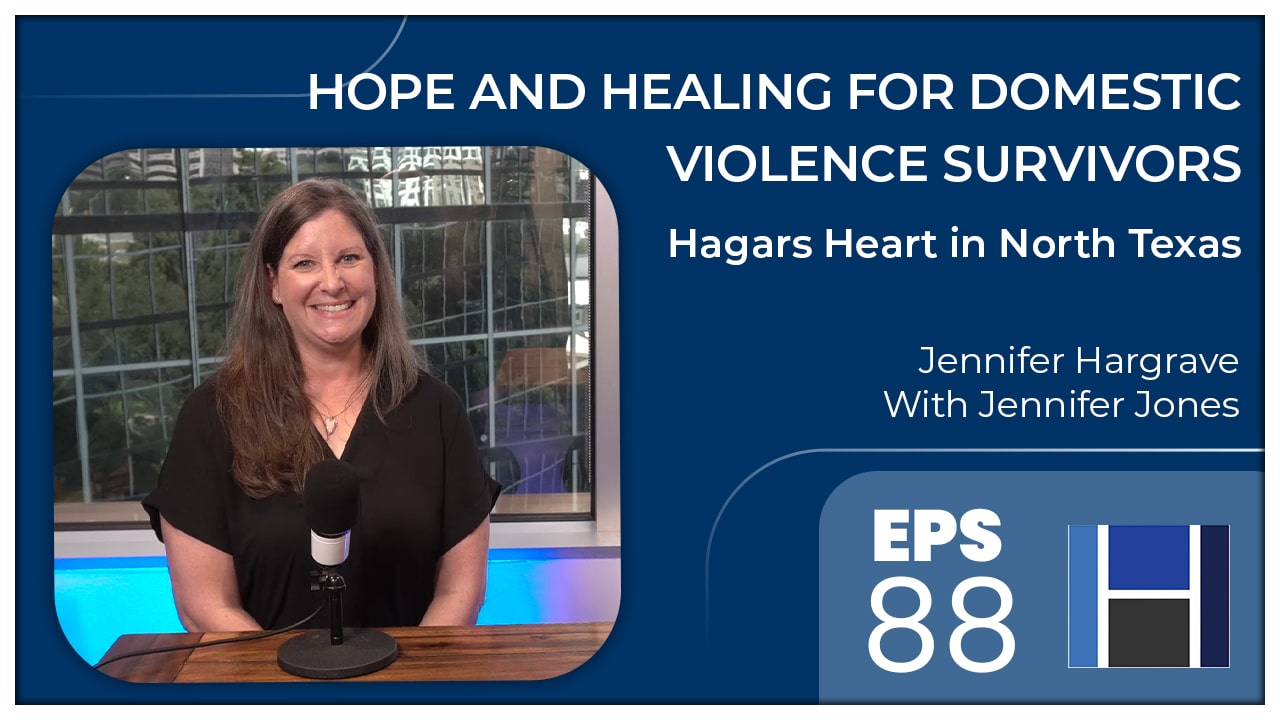
Jennifer Hargrave welcomes back Jennifer Jones, founder and executive director of Hagar’s Heart, a North Texas nonprofit dedicated to bringing hope and healing for domestic violence survivors. What began during COVID as an online support group has grown into a powerful community partner, now working with eight agencies across three counties.
Jones shares the impact of the nonprofit’s monthly “I See You” (ICU) Boxes—filled with self-care items, handwritten letters, and affirmation bracelets—that remind survivors they are not invisible. She explains the biblical inspiration from Genesis 16:13, the importance of addressing emotional and verbal abuse, and how events like the Women’s Day Brunch, Father’s Day Barbecue, and Santa’s Shack bring dignity to survivors and joy to their children.
Together, Jennifer and Jennifer discuss the realities of leaving abusive relationships, the persistence of triggers, and the power of community in fostering resilience. Most importantly, they highlight the difference between hoping someone else will change and choosing hope for your own future.
This uplifting episode offers both practical resources and encouragement for survivors, their loved ones, and anyone seeking to better understand how to support healing after abuse in the Dallas–Fort Worth community.
Transcript:
Jennifer Hargrave: If you—or someone you know—are in a relationship that involves any kind of abuse, whether emotional, financial, or physical, you’re not going to want to miss this episode. I’ve invited one of our favorite guests, Jennifer Jones, back for a second show. Jennifer is the founder of Hagar’s Heart, a nonprofit dedicated to helping victims of domestic abuse—survivors, as they’re also called—overcome and begin their new lives. She’s here to talk about everything Hagar’s Heart is doing and to share a bit of her own story. Hi, Jennifer.
Jennifer Jones: Hey! I can’t believe it’s been five years since we were sitting almost right here and I had just started taking action on a vision for Hagar’s Heart. Now, five years later, so much has changed.
Jennifer Hargrave: Tell us what’s going on.
Jennifer Jones: We started during COVID, and even our mission has evolved. I began with an online group that kept growing. Today our mission is to support, educate, and empower domestic violence survivors—men and women—through self-care support. Back then I talked about our ICU Box; it’s grown so much. We now partner with eight agencies in three counties, and we’ve met and shared healthy ways to heal from emotional and verbal abuse with about 8,600 men and women through the boxes and our events. I laugh when you ask what’s next, because we’re not done. Five years ago we were a newborn; now we’re a toddler. We’ll have an adolescent phase, too!
Jennifer Hargrave: Take me back to the ICU Boxes. When I hear “ICU,” I think “intensive care unit,” but this is “I See You.” What’s the origin?
Jennifer Jones: It’s based on my story—healthy healing after divorce, learning to move beyond titles and codependency. The inspiration also comes from Hagar in the Bible, Genesis 16:13. In two rough patches—my divorce and later leaving education after 20 years—that verse met me differently each time. “I now see the One who sees me.” Years ago, it told me I mattered after living through verbal and emotional abuse. In 2018, it reminded me I was more than my job title. That truth ignited my healing and became Hagar’s Heart.
Jennifer Hargrave: What’s inside the box?
Jennifer Jones: Items that prompted healthy self-care in my own healing. I used to think, “If my kid’s okay, I’m okay.” I’ve learned I needed to focus on me, too—even now that he’s a young adult. My tribe—best friends, my family, my mom—surrounded me with small acts: positive notes, a pedicure, a meal, journaling. People sometimes assume Hagar’s Heart is toiletries—we’re not. The “I See You” Box has 17 items designed to spark moments like, “That felt good,” instead of crying all day when your world falls apart. The two most-loved pieces are the handwritten letter and a handmade bracelet with a positive word, so when she looks at it, she knows she’s enough. We also include a card with simple guidance for those moments when trauma makes it hard to think: “Look at your bracelet,” “Read this card,” “You are enough.” At first no one wanted to handwrite letters; now we get them mailed from all over. Recipients—women and men—say, “I can’t believe someone was thinking of me.”
Jennifer Hargrave: And so many ways to contribute—write letters, make bracelets, sponsor box-making days. You’ve had some big supporters.
Jennifer Jones: We have. In 2020, volunteer hours were still required, but it was hard to gather. Our boxes made sense for corporate groups. We’ve been supported by people all over DFW—Target, Walmart, Higginbotham—and of course Hargrave Family Law. Your team packs boxes every holiday season—journals, chocolate, small manicure sets, the bracelet, the letters—it’s powerful community support.
Jennifer Hargrave: How are the boxes distributed, and what feedback do you receive?
Jennifer Jones: We deliver monthly—150 to 300 boxes depending on the season. Our eight partner agencies include 11 emergency shelters. We also partner with One Safe Place in Tarrant County, a one-stop center. When someone comes in and tells their story for the first time, they receive a box. Shelters are reaching out to us now because the need is great—one in three women and one in seven men experience this. I’d love to be put out of business, but the numbers aren’t declining. Partnering with The Family Place, which has one of only two men’s shelters in the U.S., has helped us learn what men need; it can be different from women.
Jennifer Hargrave: Beyond the boxes, you host events. Tell us about those.
Jennifer Jones: We launched around Mother’s Day 2020—when everyone was stuck at home. It hit me that I had been able to leave and set boundaries, but many women couldn’t. Our first event was a Women’s Day Brunch (we renamed it from Mother’s Day Brunch because not all survivors are mothers, and sometimes the abuser isn’t the children’s father). We’ve met hundreds of men, women, and children through events. We also host a Father’s Day Barbecue. Our biggest coming up is Santa’s Shack. My “tribe” always made sure my child could give me a gift; that inspired Santa’s Shack. Kids shop for their moms, wrap the gift, and make a card, while volunteers give moms the gift of time. This year, thanks to a generous grant from Thrive Causemetics, we’ll pamper the moms with donated makeup while the kids shop. It’s joy-filled for the children and deeply honoring for the women.
Jennifer Hargrave: I’ve volunteered at Santa’s Shack and the Women’s Day Brunch—it’s moving to watch children experience the joy of giving. What else have you learned in five years?
Jennifer Jones: That domestic violence is more than a black eye. The hidden parts—emotional, verbal, psychological abuse—can linger the longest. Every event affirms the reality and the hope. I can “preach” self-care, but this past year I’ve really lived it. We spend October—Domestic Violence Awareness Month (alongside Breast Cancer Awareness Month)—on education. We’re screening “Moving to Ordinary Love” by local producer Tracy Rector on September 30 in Dallas. After the film we host a panel—law enforcement, legal, agency leadership, counselors—to unpack why survivors often return seven times on average and the obstacles they face.
Jennifer Hargrave: People often ask, “Why did you stay?”
Jennifer Jones: It’s the hardest question. People think it’s easy to leave. It isn’t. I stayed because of hope—hope he would change. I left and came back when it felt safe; it didn’t change the dynamic. Through therapy—I go weekly and I’m worth it—I’ve learned the triggers may remain, but how you handle them gets better. Forgiveness was part of my healing, and it was for me, not for him.
Jennifer Hargrave: There’s a big difference between hoping someone else will change and choosing hope for yourself—a future you control.
Jennifer Jones: Exactly. Fifteen years into my second chance, I see what a healthy relationship looks like. We’re not perfect, but disagreements are handled differently. I don’t live in fear that every hard day means divorce. For survivors I meet—in shelters and out—I want them to know: you’re not alone. Our parents’ generation kept everything under the rug; isolation breeds shame. We’re breaking that by being open.
Jennifer Hargrave: I like to end with a message of hope. Speak to the you from 19 years ago—when hope meant waiting on someone else to change. What would you say?
Jennifer Jones: Live your life on your terms. Your decisions are okay, even if others disagree. You’ll be supported in ways you can’t yet imagine—by people, volunteers, donations. Take the leap of faith—whether the abuse is financial, spiritual, physical, or emotional. The leap is hard at first, but the blessings on the other side are real. Don’t be afraid to jump.
Jennifer Hargrave: Beautiful. If you—or someone you love—are in a broken or unsafe relationship, please share this episode and look up Hagar’s Heart. There are so many ways to give and make a difference. Thank you for joining us, and we hope you’ll stay tuned for future episodes.
If you would like to learn more about Jennifer Jones and her mission, please visit: