When Divorce Crosses Borders: International Divorce and Custody in Texas
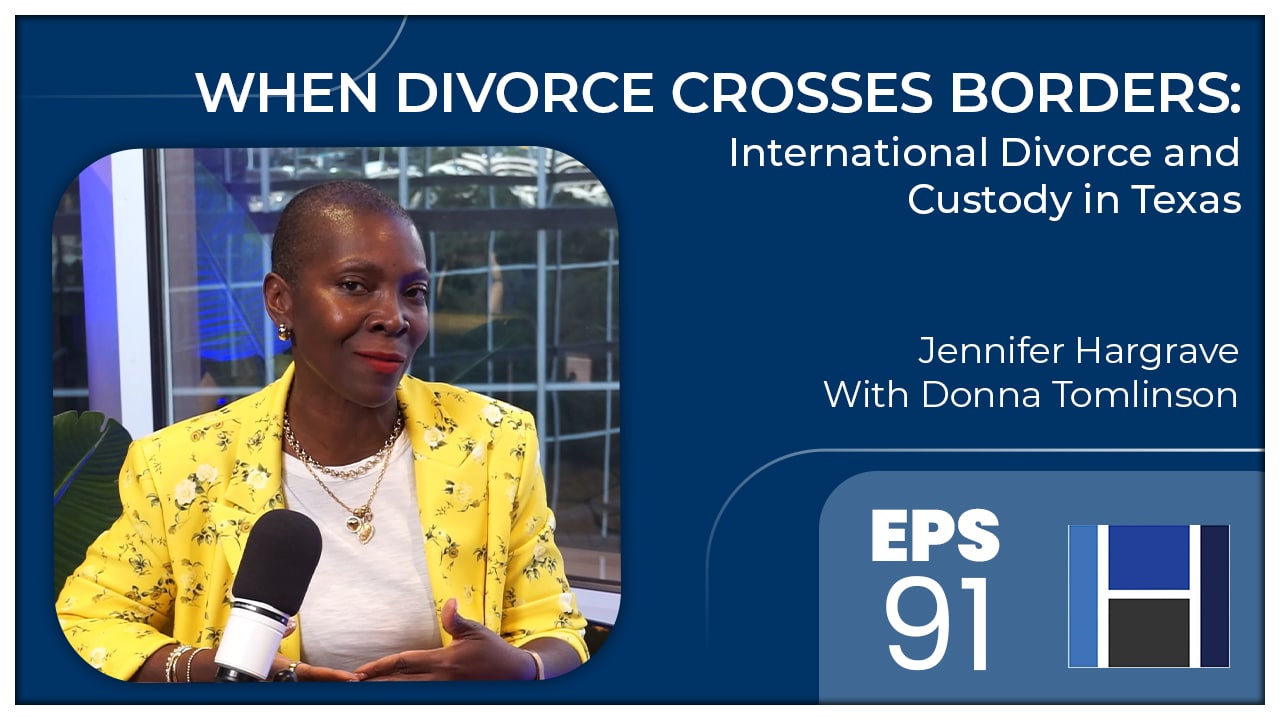
When love and family span across borders, divorce can get complicated fast. In this episode of The Jennifer Hargrave Show, Dallas divorce attorney Jennifer Hargrave sits down with Donna Tomlinson, a family law attorney at Hargrave Family Law, to discuss the challenges of international divorce and child custody cases.
They unpack crucial topics like jurisdiction, the Hague Convention, travel restrictions, and how Texas courts handle international custody disputes. Donna also shares insights about helping families overcome language barriers, recognizing foreign divorce judgments, and working with attorneys abroad to protect children and assets.
Whether you’re facing a cross-border divorce or simply curious about how Texas courts handle global family law issues, this episode offers clarity, compassion, and hope.

Transcript
Jennifer Hargrave:
North Texas is an incredibly diverse community—and it’s no wonder. With our booming economy, people from all over the world are moving here. But that diversity can create unique challenges when it comes to divorce, especially when international issues are involved.
My guest today is Donna Tomlinson, an attorney with Hargrave Family Law. Donna received her Juris Doctorate from South Texas College of Law and her LLM in Taxation from the University of Florida. While she studied tax law for many years, she now practices family law, and we’re so excited to have her here to talk about the international issues we’re seeing more frequently in family law cases.
Donna, thank you so much for being here.
Donna Tomlinson:
Thank you for having me, Jennifer. I’m excited to be here.
Jurisdiction and International Complications
Jennifer:
Let’s start with one of the first things that comes to mind—jurisdiction. It’s not the most glamorous topic, but it’s so important for people to understand. How does jurisdiction work in family law cases, especially when international factors are involved?
Donna:
Absolutely. In Texas, at least one spouse must have lived in the state for six months and in the county where they’re filing for at least three months.
Things get more complicated when one spouse lives in another country. You have to figure out how to properly serve that person abroad and determine whether the Texas court can divide property located in another country.
If there are children involved, we also have to ask whether a Texas court can issue orders that will be recognized in that other country. Jurisdiction really shapes how smoothly and quickly a divorce can proceed because you’re often dealing with red tape and international legal procedures before you can even get to the heart of the case.
Jennifer:
Exactly. Jurisdiction determines which court has the power to make binding decisions. And when international issues are involved, we’re dealing not only with state laws but also international laws.
Can you talk a bit about that layer?
Donna:
Sure. I’m originally from Jamaica, which follows the Commonwealth legal system. That means our laws can differ quite a bit from those in the U.S.
When you have an international marriage, the laws of both countries might handle divorce, custody, and property issues differently. For example, with children, one country might handle custody disputes through a completely different process. So we have to reconcile those differences when seeking resolution.
Another big question is whether Texas even has the right to make decisions about a spouse living abroad. The court must determine whether that person has enough connection—or “minimum contact”—with Texas for the court to have authority over them. And sometimes, the answer is no, which adds another layer of complexity.
The Hague Convention and Child Abduction Cases
Jennifer:
A phrase that comes up a lot in these cases is the Hague Convention. Tell us what that is.
Donna:
The Hague Convention is crucial in international family law. It’s an international agreement among certain countries that sets out procedures for returning a child who has been wrongfully removed or retained across borders.
For example, let’s say one parent takes the child to another country for a visit and then refuses to return them. The Hague Convention allows participating countries to cooperate in returning the child to their “home state”—the country where they’ve lived for at least six months.
But if the other country isn’t part of the Hague Convention, it becomes much more difficult to get the child back. That’s why, if a spouse lives abroad, it’s essential to inform the Texas court right away so safeguards can be put in place.
Jennifer:
What kind of safeguards can courts use to reduce that risk?
Donna:
Courts can issue very specific orders, such as requiring travel documentation, notifying the State Department and relevant embassies, and setting travel restrictions. These details can be written into the divorce decree.
I also advise parents to file those court documents with the embassy and the State Department. That way, if something goes wrong, there’s proof that Texas is the child’s home state and that precautions were in place.
Jennifer:
What about if the other parent lives in a country that’s not part of the Hague Convention?
Donna:
In that case, the safest option is to request that visitation occur here in the U.S. Courts can also restrict international travel or require that passports be held by one parent or even the court itself.
It gets tricky if the child has dual citizenship and multiple passports, but with proper planning, these risks can be managed.
Jennifer:
Right—and of course, most judges want to support healthy relationships between children and their extended families abroad. So it’s all about balance and ensuring safety.
Donna:
Exactly. Many families successfully arrange for international visitation, like children spending summers abroad. But it’s still wise to have those protective measures in place because life circumstances can change.
Language Barriers and Access to Justice
Jennifer:
Let’s shift to another challenge—language barriers. Many people in North Texas speak English as a second language, and some don’t speak it at all. How does the court system accommodate them?
Donna:
Courts can provide certified interpreters to assist parties who don’t speak English fluently. However, there are limitations—some languages simply don’t have many certified interpreters available.
One option is to bring your own translator to meetings with your attorney, even if they’re not certified, to help with communication. You can also have key documents translated in advance for the court.
Still, this is a nationwide issue. We need more certified interpreters and more flexibility in allowing qualified translators to assist in court so that everyone has fair access to justice.
Jennifer:
Absolutely. It’s a due process issue, and hopefully, continued advocacy will help modernize those rules.
Recognizing Foreign Divorce Judgments
Jennifer:
Another question we see from time to time: If a couple from Texas gets divorced abroad—say, while traveling or visiting family—will Texas recognize that foreign divorce decree?
Donna:
That’s a great question. The first step is to register the foreign judgment in Texas so the court can review it. However, if the foreign laws conflict with Texas law, the Texas court may not enforce that decree.
That’s why it’s so important to consult with lawyers in both countries before proceeding, to ensure there are no major contradictions in the laws.
Jennifer:
And I know you’ve built relationships with attorneys in other countries to help navigate these issues.
Donna:
Yes. Collaborating with local counsel abroad is invaluable. Legal systems and enforcement mechanisms vary widely. For instance, in Kenya, law enforcement can be more directly involved in family matters than what we’re used to here in Texas. Having local guidance helps you understand those nuances and serve your clients better.
Donna’s Journey to Family Law
Jennifer:
You mentioned you’re from Jamaica. How did you find your way into family law?
Donna:
It’s been quite a journey! I originally wanted to practice international corporate law. I came to the U.S. on a full academic scholarship to Prairie View A&M University, then went on to law school and worked in tax and securities law.
But after the 2008 market downturn, I reevaluated—and after going through my own divorce, I realized family law was where I could make a real difference. I found great satisfaction in helping people through such emotional and transformative times in their lives.
Jennifer:
And you truly live that out.
Donna:
I do! I’ve been divorced twice, so I understand the emotional side firsthand. I share parts of my story with clients to let them know there’s no judgment here—I’ve walked that road too. It helps them open up and feel supported.
A Message of Hope
Jennifer:
As we wrap up, what message of hope would you share with someone who’s struggling right now—maybe unsure whether to stay or leave a marriage?
Donna:
I’d say: really reflect on who you are and what you need to thrive. If you have children, ask yourself whether you’re able to be fully present and emotionally healthy for them in your current situation.
Children pick up on tension and learn from our relationships. Sometimes the bravest, healthiest thing you can do is walk away after trying your best. You’re not failing—you’re creating a safe, peaceful space for yourself and your children to grow.
Jennifer:
Beautifully said. Donna, thank you for sharing your wisdom and experience today.
Donna:
Thank you for having me, Jennifer.
Jennifer:
If you’d like to learn more about Donna or her work, we’ve included a link below. Be sure to subscribe to The Jennifer Hargrave Show for more insights on family law and life transitions.
If you would like to learn more about Jennifer Jones and her mission, please visit: