2026 Texas Standard Possession Calendar
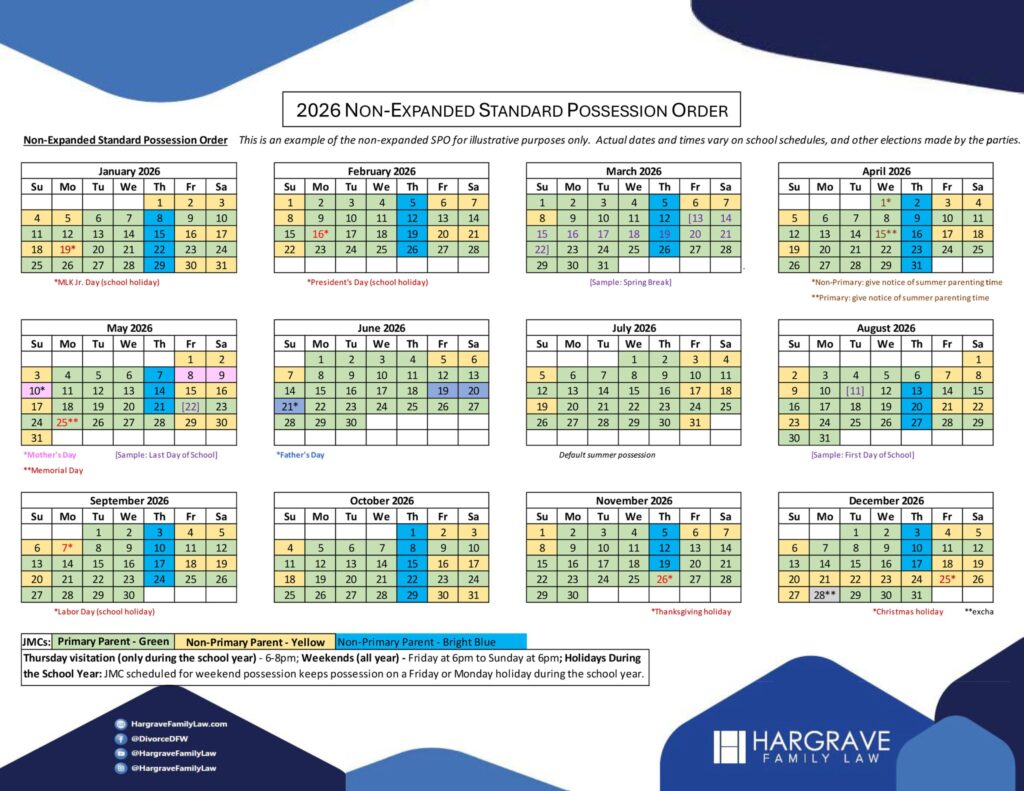
2026 Texas Expanded Standard Possession Calendar
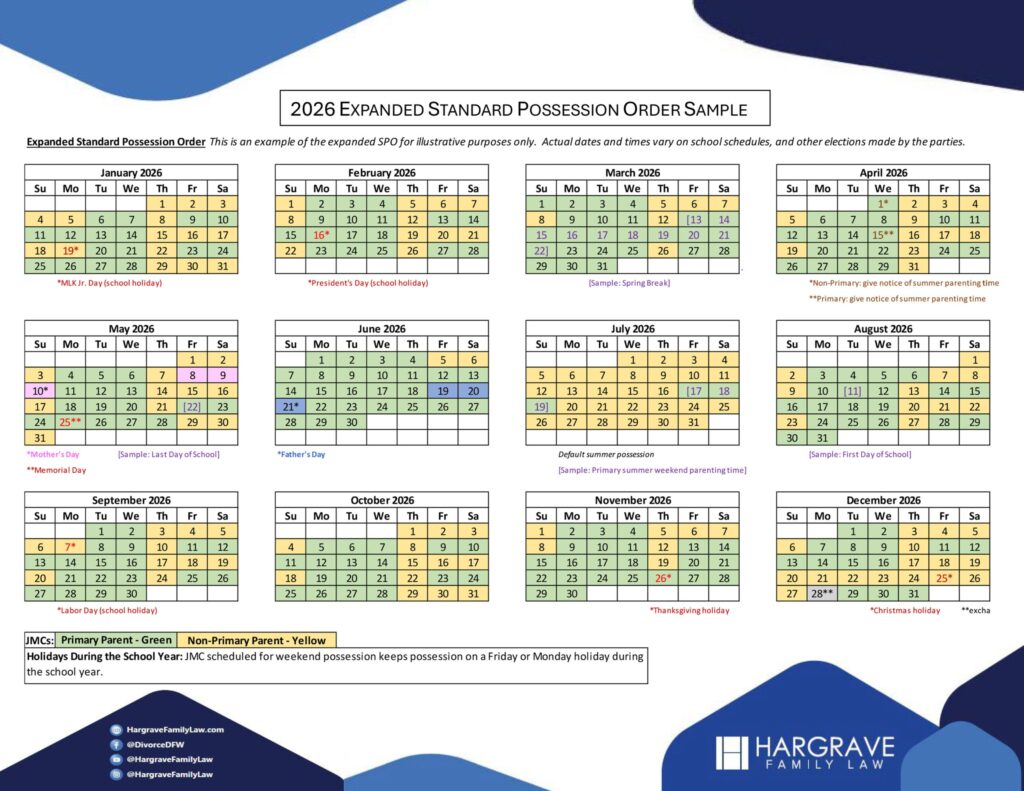
How much time you will be spending with your child is a primary concern for most people facing divorce, or separation from the other parent. In fact, fear of missing time with their children is a leading reason people often choose to stay in broken relationships. Most parenting schedules utilized by the courts provide on average a 40-60 split of time, with the non-primary parent having about 40% of the time with their children. This starts with the two parenting schedules the courts use, the Standard Possession schedule and the Expanded Possession schedule. However, two parents can collaborate and create a schedule that works for their family and present it to the court for approval. Many parents these days are agreeing on an equal 50-50 split of time, with parents choosing a child custody schedule such as week-on/week-off. While there are as many variations to parenting time schedules as there are families, it is nevertheless important to know what the “default” parenting calendar orders are and how they work.
The purpose of this article is to discuss the Standard Possession Order and the Expanded Standard Possession Order that apply in Texas cases, as this is usually the starting place from which many parents begin their negotiations.
Understanding the Basics of Possession in Texas
Stepping into the world of child custody can feel overwhelming. The Standard and Expanded Possession Calendars serve as schedules that outline when each parent has the right to spend time with their child. They aim to ensure that children have consistent and meaningful contact with both parents, despite the circumstances of the divorce or separation.
The 2026 Standard and Expanded Possession Calendars we’ve prepared are tools specifically crafted to simplify planning for divorced parents in Texas. Understanding how these calendars work is an important step in navigating shared custody after divorce and/or parental separation. It is also important to know that while these standard possession orders are presumed to be in the best interest of the children, there are lots of ways in which the parenting schedule can be modified to adapt to the unique needs of your family, whether that’s by agreement of the parents or by order of the court.
These calendars visually show how the possession orders work for parents who live within 50 miles of each other. Use them to track first, third, and fifth weekends, the holiday schedule, and default summer possession, as well as to plan exchanges and travel with fewer surprises. This helps you in planning ahead and helping to guide your child so their time is more predictable.
Changing the Schedule by Agreement
An important thing to know about the Possession Orders is that the parents can always agree to change the terms by agreement. To ensure there are no misunderstandings, any agreement to vary the terms of the Possession Order should be in writing and approved by both parents. This allows the parents to make changes based on the parent or child’s schedule without having to go back to court for a formal Order to change the schedule. Parents can be flexible with each other, make accommodations for the child’s activities, or adjust due to changes in the parent’s schedule. The changes can be temporary, such as to accommodate a select sports season, or permanent, such as to accommodate a parent’s work schedule changing due to a job change. If a change to the schedule is going to be permanent, evaluate whether it’s advisable to submit a new proposed Order to the court to get it formally changed. Much of that will depend on the health of your co-parenting relationship. Seek guidance from an experienced Dallas divorce attorney to help you determine if this is necessary.
How the School Calendar is a Factor
The next thing to know is that “school” is defined as the elementary or secondary school in which the child is enrolled. If your child has not yet reached school age, then the schedule will follow the school calendar for the public school district in which the child primarily resides. The school calendar is important to the Possession Order, as it will dictate the holiday and summer schedules. Time is structured around public school schedules, holidays, and weekends, making it easier for parents and children to plan their time together and reduce the potential for misunderstandings.
Commonly Used Terms for the Texas Standard Possession Calendar
Custodial Parent or Managing Conservator (referred to herein as CP). These terms are used to refer to the parent who has the exclusive right to designate the primary residence of the children. This parent will have slightly more time with the children under the Standard and Expanded Possession Order.
Non-Custodial Parent or Possessory Conservator (referred to herein as NCP). This is a term used to refer to the other parent who does not have the exclusive right to designate the primary residence of the children. They will have slightly less time with the children.
Here is an overview of the possession schedule for parents who live within 50 miles of each other. There are many details to the Possession Order, and this overview does not address all the nuances, so it is important to actually read the actual language in your Final Decree or Order that governs your case.
However, we believe it is beneficial for parents to have a basic overview of the standard Order, so we have simplified it for the purposes of this article. It is important to note that if the parents live farther apart than 50 miles, there are variations to the Standard Possession Order (which are not covered in this article).
- Weekend Possession During the School Year– The NCP will have the children on the 1st, 3rd and 5th weekends of the month, generally beginning at the time school is dismissed on Fridays and ending at the time school resumes on Mondays. The beginning and ending times may change if there is a school holiday. (Weekends are determined by Fridays, so this applies to the 1st, 3rd and 5th Fridays of the month).
- Thursdays During the School Year – The NCP will have the children every Thursday during the school year. Standard Possession includes time with the child from 6 pm – 8 pm only. Expanded Standard Possession includes time with the child generally beginning at the time school is dismissed on Thursdays and ending at the time school resumes on Fridays.
- Summer Possession for the NCP – Under Standard Possession, the NCP will have the 1st, 3rd and 5th Weekends beginning at 6 pm on Friday and ending at 6 pm on Sunday. Expanded Standard Possession additionally allows the NCP to have 30 days during the summer, with the right to designate the 30 days by April 1. If no designation, then the default summer possession is July 1 through July 31.
- Holidays – The only holidays that are covered by the Standard Possession Order are Thanksgiving, Christmas/New Year’s, Spring Break, Father’s Day and Mother’s Day. The NCP will have possession as follows:
- Thanksgiving (Odd Years) – Beginning at the time the child’s school is dismissed for the Thanksgiving break and ending at 6 pm on the Sunday following Thanksgiving.
- Christmas Break Part 1 (Even Years) – Beginning at the time the child’s school is dismissed for the Christmas break and ending at Noon on December 28th.
- Christmas Break Part 2 (Odd Years) – Beginning at Noon on December 28th and ending at 6 pm on the day before school resumes following the Christmas Break.
- Spring Break (Even Years) – Beginning at the time school is dismissed for Spring Break and ending at 6 pm on the day before school resumes following Spring Break.
- Father’s Day OR Mother’s Day – Beginning at 6 pm (or the time school is dismissed) and ending at 8 am on the Monday following the parent’s day (or at the time school resumes).
The Custodial Parent then has possession of the child at all times not designated for the PC, with the following additional time carved out for the Custodial Parent:
- Summer Possession for the CP – The CP will have the right to designate one of the NCP’s regular 1st, 3rd or 5th weekends (which gives the CP an extended period of summer possession). Also, in the Expanded Possession schedule, the CP will have the right to designate one weekend during the NCP’s 30 day period of possession.
- Holidays – The CP will have possession as follows:
- Thanksgiving (Even Years) – Beginning at the time the child’s school is dismissed for the Thanksgiving break and ending at 6 pm on the Sunday following Thanksgiving.
- Christmas Break Part 1 (Odd Years) – Beginning at the time the child’s school is dismissed for the Christmas break and ending at Noon on December 28th.
- Christmas Break Part 2 (Even Years) – Beginning at Noon on December 28th and ending at 6 pm on the day before school resumes following the Christmas Break.
- Spring Break (Odd Years) – Beginning at the time school is dismissed for Spring Break and ending at 6 pm on the day before school resumes following Spring Break.
- Father’s Day OR Mother’s Day – Beginning at 6 pm (or the time school is dismissed) and ending at 8 am on the Monday following the parent’s day (or at the time school resumes).
The Possession Orders also provide general terms and conditions for picking up and dropping off the child at the beginning or ending of possession periods. When school is in session, many of the exchanges will occur at school thereby minimizing parental interaction. However, during the holidays and summers, parents will need choose drop off/pick up locations, usually at each other’s homes. Other options can include a neutral place such as a restaurant or play space or a point midway between homes.
Customized Provisions for the Expanded Possession Calendar
The Texas Family Code anticipates that one possession calendar will not fit all families. That is why parents have wide latitude in negotiating the terms of their possession calendar to structure it to fit their unique situation. Judges also can vary from the statutory Possession Calendar to address unique family situations.
For example, if a parent works in the emergency services field, such as an EMT, firefighter or police officer, their work schedule often does not fit within the parenting time calendar. Therefore, parents can structure the possession schedule so that the parent working shifts can have time with their children when they are not on call.
Likewise, there are many provisions that parents can negotiate or that courts may order that are in addition to the standard provisions including the following:
- Other Holidays: Parents who have other religious holidays not contemplated by the standard Possession Orders that they want to celebrate with their children (e.g., Easter, Rosh Hashanah, Ramadan, Diwali, etc.) can negotiate their inclusion.
- Right of First Refusal: If a parent who has possession of the children is going to be gone for a period of time during their possession, then the other parent may be given the right to care for the children in that parent’s absence. These provisions can be tricky, and need to be drafted with care so as to not become overly intrusive.
- Children’s Activities: If a parent is unable to take the child to a scheduled activity, then the other parent may be given the right to take the child if he or she is available.
Differences between the Standard and Expanded Possession Calendar
In previous years, the Standard Possession Order as set forth in the Texas Family Code provided less overnight options than the Expanded version of the Standard Possession Order. However, this was changed in 2021, such that the Standard Possession Order now includes many of the extra overnights for the non-custodial parent when the parents live within 50 miles of each other. Whether you have an old version of the SPO or the updated version of the SPO will depend upon when your case was filed, and whether you were following the expanded version or not.
Ultimately, the Standard Possession Order is intended to provide parents with substantial parenting time with their child(ren), and is therefore presumed to be in the best interest of the child, ensuring both parents spend quality time with their child(ren). A reminder: if you already have a possession order in place, it is important that you follow the specific terms of your possession order.
Tips for Adapting to the 2026 Expanded Possession Calendar
Parties to a divorce can spend a lot of time negotiating and working through the terms of a possession order. The possession order provides a framework for times when there is not another agreement between the parents regarding possession. That is why it is important to understand how the possession order works. Here are a few tips for getting the most from your scheduled time with your children:
- Communicate openly with your ex-partner about the schedule. It is helpful if you have a family platform you can use for communication, such as a shared Google calendar or a web based application like Our Family Wizard.
- Plan activities in advance to make the most of your time with your child. Stay on top of events that your child is interested in attending, such as extra-curricular activities or birthday parties of friends. If you can’t take the child to an event that is important to him or her, ask the other coparent if they are willing to help (but remember they have the right to say no).
- Be flexible — life happens, and unforeseen circumstances can arise that may require changes to the schedule. If you need to travel for work, or attend an event, give the other parent plenty of notice if they want to care for your child during your absence. Alternatively, be prepared to make your own childcare arrangements.
- Keep a positive attitude. Your child will pick up on your emotions, so try to approach the schedule with optimism. Support their time with the other parent.
- Avoid tit for tat. It’s too easy to make decisions based on how you feel like the other parent is treating you. However, keep your decisions based on what is best for your child. Allowing a little extra time for the child to attend a family gathering, or giving grace when the other parent is running late, set the tone for how you want to coparent. Even if the other parent is not reciprocating right away, doing right by your child is always the right thing to do.
The 2026 Standard and Expanded Possession Calendars are a valuable tool in navigating child custody arrangements. By understanding its structure, adapting to its rhythm, and using it as an opportunity to enhance your relationship with your child, you can turn a challenging situation into an opportunity for growth and connection.
The 2026 Standard and Expanded Possession Calendars are not just a tool for scheduling. With both scheduled time and flexibility, parents have more opportunities to engage in meaningful activities with intention, creating lasting memories and strengthening their bond. By following the schedule, parents can ensure their child benefits from consistent contact with both parents, fostering a sense of stability and security that is crucial for their development.
To navigate these complex custody schedules and ensure the best outcome for your child, consider reaching out to our team of experienced child custody lawyers at Hargrave Family Law. Our team of dedicated professionals is here to guide you through every step of the process, prioritizing your child’s best interests.
Dallas Metroplex Child Custody Resources
- Texas Child Support: Navigating Complex Situations
- Guide to Medical & Dental Support in Texas
- Five Ways to Enforce a Child-Support Agreement
- What Happens to Child Support if You Change Jobs?
- Understanding Child Abandonment
- Visitation Activities for Non-Custodial Parents
- When Your Teen Refuses to Visit a Non-Custodial Parent
- Custody Conflicts: Five Child-Focused Challenges
- Find a Dallas Child Custody Lawyer
Helping Families Find the Right Custody Solutions
The experienced attorneys of Hargrave Family Law are here to help with your child custody disputes and other family law needs. Whether you need a standard visitation schedule approved by the Court or a creative solution that works for you and your co-parent’s unique situations, reach out to us today to find out if we can help you find the right solution for your family.