How to Get Unstuck in Life and Relationships: Counseling vs Coaching
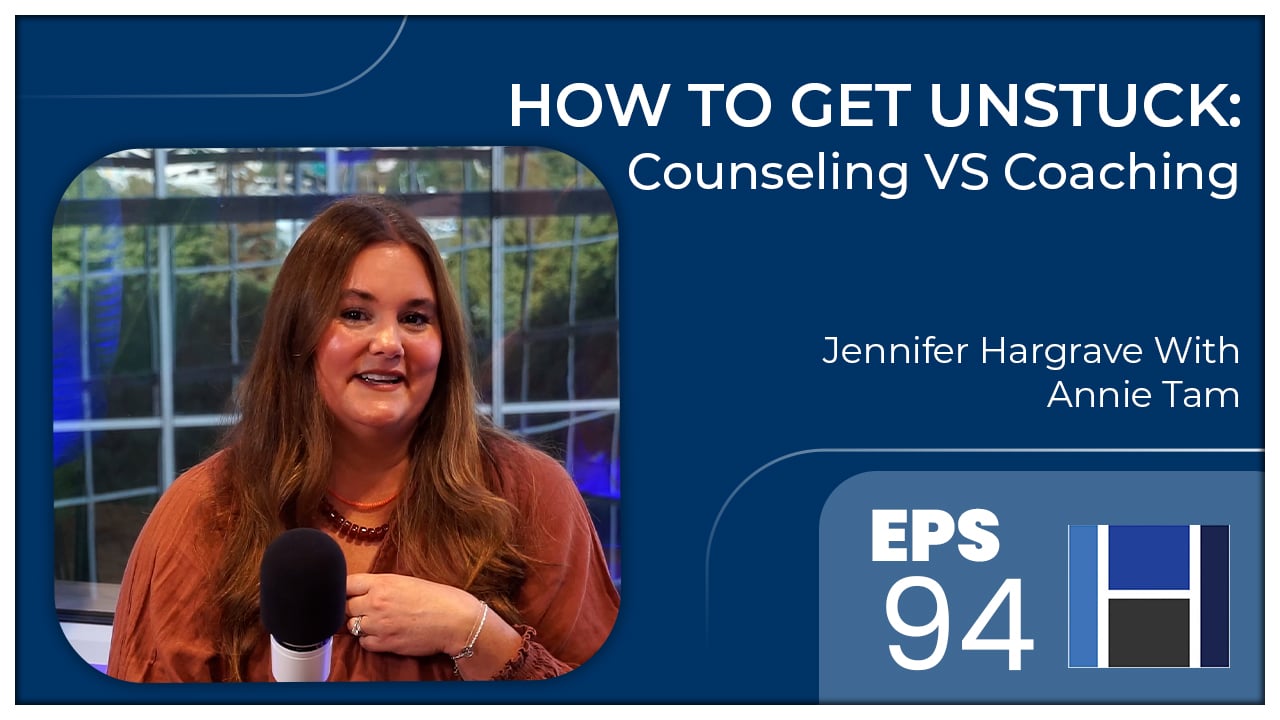
Feeling stuck can show up anywhere—your career, your relationship, your parenting, or even inside your own perfectionism. In this episode, Dallas divorce lawyer Jennifer Hargrave sits down with licensed professional counselor Annie Tam, an expert in helping high-achievers, working moms, and entrepreneurs move through overwhelm and decision fatigue.
Annie breaks down what “stuck” looks like, why achievers and people-pleasers are especially vulnerable, and how identifying your core values (typically 3–5) can create clarity when everything feels too heavy. She shares practical tools like Do, Ditch, Delegate to reduce overload and create real momentum—both at work and at home.
The conversation also dives into getting unstuck in relationships, including how values can give you clearer language than blame, and why focusing on what you can control is the first step toward reclaiming your power. Finally, Annie explains the difference between counseling and coaching and offers an accessible overview of EMDR and how it can help people process stuck emotions, triggers, and trauma responses.

Jennifer Hargrave:
Do you ever feel stuck in life? Maybe you feel stuck in a professional career that just isn’t going the way you want it to, but you have all these expectations on you. Or maybe you feel stuck in a relationship—one you can’t seem to leave, even though you’re unhappy.
If that sounds familiar, you’re not alone. And my guest today is Annie Tam.
She’s a licensed professional counselor and an expert in helping people get unstuck. Annie works with working moms, entrepreneurs, and perfectionists—this is truly her area of expertise. We’re so excited to sit down with you today, Annie, to talk about counseling, coaching, and what it really looks like to move through periods of stuckness.
Annie Tam:
Thank you so much, Jennifer, for having me. I’m really excited to talk about getting unstuck and the different ways we can do that.
Jennifer:
Let’s start at the beginning. Why do we get stuck? What does it actually look like when someone is stuck?
Annie:
Oftentimes, people are just done. They’re overwhelmed. They have decision fatigue. They can’t move forward.
A lot of these people are achievers—they’ve been going and going their whole lives. And suddenly, they find themselves in a place they don’t understand, and it’s incredibly uncomfortable because it’s not somewhere they’re used to being.
Jennifer:
Especially for achievers—when you’re used to being the decision-maker and suddenly you’re not in control of everything anymore.
Annie:
Exactly. Sometimes you are still making decisions, but there are just so many moving parts. Life used to be simpler, and now it’s not.
I see this a lot with entrepreneurs. As their businesses grow, they’re managing more people, more systems, more interests. And it becomes overwhelming.
Jennifer:
And that same thing happens in personal life too—marriage, in-laws, kids, schedules. Everything multiplies.
Annie:
Yes. You start with just you. Then you add a partner. Then children. Then extended family. And suddenly every decision involves multiple people.
And for people who grew up taking care of others or pleasing others, that pressure can be even heavier. You’re constantly asking, Is everyone else okay? That becomes the measuring stick for how you’re doing.
Jennifer:
Which is exhausting.
Annie:
It really is. Especially when you no longer have that external feedback—no one telling you, “You’re doing a good job.” That adds to the overwhelm and feeling stuck.
Moving Out of Overwhelm
Jennifer:
So how do we step into a new paradigm? How do we move out of overwhelm?
Annie:
It looks different for everyone, but I always start with values.
We have to ask: What is most important to me right now?
Once we identify our values, we can see where we’re honoring them and where we’re not. That helps us determine our priorities.
We all have endless to-do lists. But we can’t do everything. Values help us decide what actually matters.
Jennifer:
People hear “clarify your values” all the time, but what does that actually look like?
Annie:
It depends on your personality. For many people, doing this with someone else—a therapist, coach, or trusted friend—is really helpful.
I love using values card decks because they introduce values people wouldn’t normally think of. Everyone says family, faith, love—but there are so many others that matter deeply.
I also use Brené Brown’s values list, breaking it into small sections so it’s not overwhelming.
And I pay attention to the body. When I say a value, how does your body respond? What thoughts or memories come up? That helps determine whether a value truly resonates.
Jennifer:
How many core values should someone have?
Annie:
Three to five.
Most values are good things, so narrowing them down is hard. But remember—this is flexible. Some values stay constant, others change with seasons of life.
Perfectionists often want to “get it right,” but this is an evolving process.
Values as Your Operating System
Jennifer:
Whether we identify them or not, our values are already our operating system.
Annie:
Exactly. If someone values busyness—even unconsciously—they’ll prioritize being busy over rest or meaning. That can create internal conflict.
Sometimes it’s helpful to ask people who know you well, “What do you think I value?” Their answers can be very revealing.
Then we can refine the language. Maybe it’s not “busyness,” but “productivity.” And then we ask—what does productivity really mean?
For me, as an Enneagram One, I had to reframe rest as productivity. Rest produces clarity, energy, and better leadership.
Jennifer:
That’s huge.
Annie:
Without rest, you’re not productive at all.
Practical Tools: Do, Ditch, Delegate
Jennifer:
Once values are clear, how do we apply them practically?
Annie:
We set values-based goals, then evaluate our to-do list through that lens.
My favorite tool is Do, Ditch, Delegate.
You take your list and ask:
- What do I need to do today that aligns with my values?
- What can I ditch or move to another day?
- What can I delegate?
I challenge clients to delegate at least one or two things daily.
Jennifer:
Delegation is hard, especially when you don’t train people well at first.
Annie:
Absolutely. Some things you delegate and let go completely—even if it’s not done your way. Other things require systems and training.
Yes, it takes time up front. But it saves massive amounts of time long-term.
Getting Unstuck in Relationships
Jennifer:
What about feeling stuck in a personal relationship?
Annie:
If someone feels trapped or powerless in a relationship, I strongly recommend counseling.
We need to focus on your needs, your values, and how you’re caring for yourself. If it’s a safe relationship, you can approach your partner with clarity instead of blame.
Often, stuckness means a value isn’t being honored. Identifying that gives you language—and power.
You can’t control your partner, but you can change yourself. And that can lead to big shifts—even if that means leaving the relationship.
Counseling vs. Coaching
Jennifer:
People are often confused about the difference between counseling and coaching.
Annie:
A simple distinction:
- Counseling looks at the past.
- Coaching focuses on the future.
If someone hasn’t done counseling before, I usually recommend starting there. Family-of-origin work is incredibly important.
Coaching is great for business owners, leaders, and people ready to move forward after doing that deeper work.
I use EMDR in both settings.
Jennifer:
Can you explain EMDR?
Annie:
EMDR stands for Eye Movement Desensitization and Reprocessing. It helps trauma—big or small—get unstuck from the nervous system.
Trauma doesn’t process normally in the brain, so it stays stuck and gets triggered later. EMDR uses bilateral stimulation to reprocess those memories.
It’s powerful not just for trauma, but also for confidence, leadership, and performance enhancement.
Annie’s Practice
Jennifer:
You founded MANN Counseling here in Dallas. Tell us about it.
Annie:
We’re turning ten this January. We’re a boutique, collaborative group practice with 12 clinicians, serving clients from age two through adulthood.
We consult constantly—with each other and with other professionals—to provide holistic care. We specialize in different modalities and often share clients to ensure they get exactly what they need.
Final Message of Hope
Jennifer:
What message of hope would you share with someone who feels stuck right now?
Annie:
There is hope. Take time to look within and discover what matters most to you.
You can get out. Everything you need is already inside you—and you can trust yourself.
Jennifer:
I love that. Thank you so much for being here.
Annie:
Thank you, Jennifer. This was wonderful.
Learn more about Annie Tam and her practice here: Annie — MEND Counseling
Couples retreat information here: A+K Collective — MEND Counseling
If you would like to learn more about Hugs Cafe and their mission, please visit: